When I was growing up, Mother taught me to keep my hands behind me when in a nice store or home with many beautiful breakable things. “Look with your eyes, not with your hands, Beth” she’d tell me as we were entering. She’d often quietly repeat that phrase to me while we were inside that store or home. And every time she’d say it, I’d either clasp my hands behind me or grab ahold of my dress just to have something in my hands instead of my hands having hold of something I shouldn’t.
Even now, over 50 years later, I still unconsciously find myself putting my hands behind my back, gripping the legs of my jeans, or in my pockets when going into a store, museum, or friend’s home. All the while, Mother’s oft-repeated “look with your eyes” is ringing in my head.
Mother and Daddy taught me to see things and see them as they are. Not just a passing glance or even an interested look but a gazing with intent for understanding. Not just a stopping to smell the roses but a stilling to search for beauty.
They taught me the need for seeing past the surface into serving a purpose.
And that kind of seeing prompts questions.
Questions like: yes, that lovely hand-painted teapot is exquisite but is it functional in carrying hot water? Yes, that finely-crafted necklace is beautiful but is its clasp strong enough to hold if I caught it on something? Yes, that gorgeous embroidered jacket is a show-stopper but would I be afraid to wear it at dinner?
Questions like those have shaped me in ways far more important than my shopping choices. They’ve helped me hone an eye for seeing beauty even when beauty is not easily perceived in something or someone. And they’ve helped me see a need in or from someone that others have missed.
In turn, questions like those help me show appreciation of a loveliness often overlooked by others.
And I think that’s one of the reasons why I love being a soil scientist.
Because soil scientists see the beauty of potential.
We see beauty in what others often take for granted or don’t even think of in the first place, i.e. soil. Many only see “dirt” as a nuisance of having to wash dirt out of clothes or off floors or from under fingernails. Yet soil scientists see beauty in the world under our feet because we know the essential purpose of soil in our world.
We know soil is an irreplaceably essential resource for life on Earth.
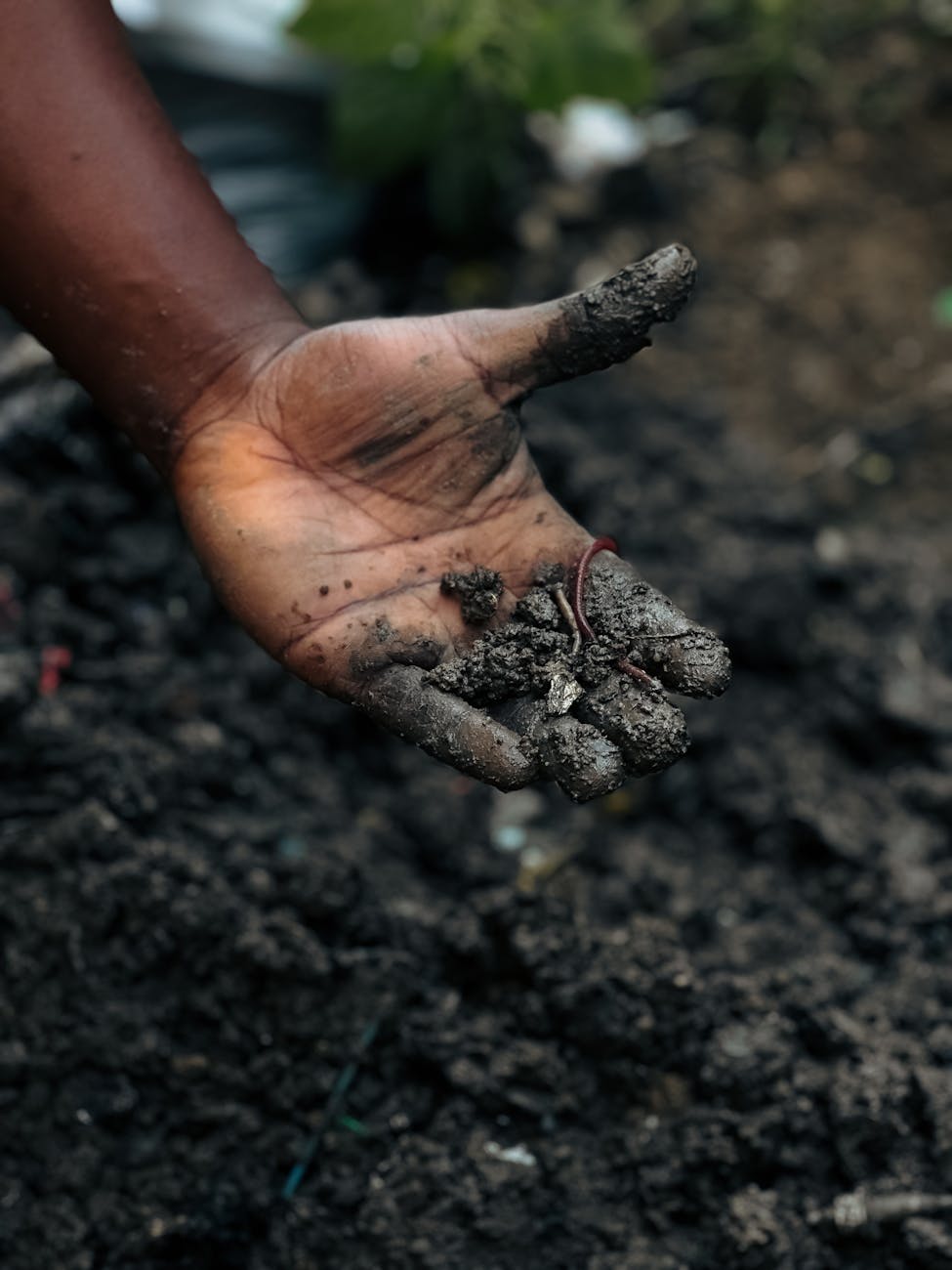
As a soil scientist, my first reaction to an exposed area of deep dark well-drained soil is to pull my hands out of my pockets or set down what I’m carrying at the moment. And then to reach down and scoop up a good handful or 2 of the soil so I can better appreciate its’ beauty close-up. To smell its’ earthy fragrance of life. To look for the little guys of bugs and worms. To feel the sands, silts, and clays between my fingers. To examine the way it sticks together (or doesn’t).
My God-given senses are my best tools for appreciating the God-given resource of a good soil.
All those beautiful things I can see, feel, or smell work together indicate a soils’ potential for bearing a rich crop with many to be helped by its harvest. And this potential makes me think yet again of one of my very favorite Bible verses. Hebrews 6:7 CSB says this, For the [soil] that drinks the rain that often falls on it and that produces vegetation useful to those for whom it is cultivated receives a blessing from God.
This verse reminds me of how God years ago reached down and scooped up some soil and formed Adam from it as seen in Genesis 2:7. At the moment God formed Adam, He already knew all of Adam, not just from the inside-out as a “mud-man” but from that moment onwards as a “made-for-more” man (see Ephesians 2:10). Also, at that point in time, God had already planned for His only beloved Son, Jesus Christ, to be the necessary payment for Adam’s yet-to-be sin (see Revelation 13:8).
God saw beyond the legacy of suffering from Adam and Eve’s sin into the potential for life for countless others redeemed by Christ, including me (see 2 Corinthians 5:21).
God saw me as I am, then.
He saw you as you are then, too.
And He loves all of us, as we are, today.
Because of Christ, God sees the righteousness of His Son when He looks at us hidden in Christ (see Colossians 3:3 and 2 Corinthians 5:21). Thus, when God looks at us, God sees Christ’s beauty in us as co-heirs with Christ in holiness (see Romans 8:17).
Our beauty to God isn’t in the shape or skin tone of our bodies, abilities or achievements, or even our obedience or obeisance. God sees beauty in us because we are His creation. And we, God’s creations, have been made beautiful because of the death, burial, and resurrection of our Jesus (see John 3:16).
Full stop.
In sharp contrast to Adam’s forming, God chose to keep His Hands behind His back during the Christ’s, i.e. the second Adam, suffering at Calvary. God stood afar off so that this beautiful work done for us through Christ might be completed in full once for all (see 1 Corinthians 15:45, John 19:30, and Romans 5:10 ESV).
Once for all.
Once for ever.
With all that in mind, we can clearly see Christ’s choosing Calvary for us as an unbreakable unshakable unmistakable beauty best seen in the darkest of circumstances and with the deepest of sinners, like me (see 1 Timothy 1:15).
Nothing remains to be added to Christ’s revealing of beauty in his life, death, burial, and resurrection. Yet everything remains for us to see His beauty revealed today and every day to follow. For us to know Him in His beauty through the lens of the fullness in life God has planned for us to know in Christ (see John 15:1-5).
That kind of life is what I long for deep in the soil of my soul…and I bet you do, too.
Thus, to know God in His beauty of a bold and solid faith compels me to keep seeking and keep seeing the beauty of God’s love for me and the beauty of Christ’s work in me. And most days, this seeking for seeing requires the hard dirty work of confession and consecration and commitment, over and over and over again.
God doesn’t just want the shiny pretty pieces of me. He wants all of me. And He tells me that in this beautiful verse: And he said unto me, My grace is sufficient for thee; for my strength is made perfect in weakness. Most gladly, therefore, I will rather glory in my weaknesses that the power of Christ may dwell in me (2 Corinthians 12:9 JUB).
That truth of seeing His beauty in my weakness and lack of beauty compels me to keep praying for all of us as Christians to make these choices:
To see past today’s trials around us into Christ’s eternal triumph over tears, pain, and grief for us.
To taste and see that our God is indeed good and that His plan is indeed best (see Psalm 34:8).
To know and live in the freedom and the strength that God’s goodness and His mercies will follow us all the days of our lives (see Psalm chapter 23).
To know and believe with full faith, we will live with Him in His house forever and ever.
Amen.
Written by and copyrighted to Beth Madison, Ph.D., 2026.


Leave a Reply